Payoneer vs Wise vs PayPal: What’s Best for SL Freelancers in 2026
If you are a freelancer in Sri Lanka, choosing the right payment platform can make a big difference in how much money you actually keep and how easily you can access your earnings. With options like Payoneer, Wise, and PayPal, it can be confusing to decide which one is best for your needs. Each platform has different fees, features, and limitations, especially when used from Sri Lanka.
In this guide, you’ll find a clear comparison of all three, so you can choose the right option, reduce costs, and get paid without hassle.
What is Payoneer
Payoneer is a US-based financial platform founded in 2005 that helps freelancers, businesses, and online sellers send and receive money across borders. It is built specifically for people who work with international clients and platforms, which makes it one of the most practical tools for Sri Lankan freelancers today.
Instead of relying on a traditional bank for international transfers, Payoneer gives you virtual receiving accounts in major currencies like USD, EUR, and GBP. Your client sends money to those accounts just like a local bank transfer in their country, and you withdraw it directly to your Sri Lankan bank account in LKR.
Here is how it works step by step:
- You sign up for a free Payoneer account and complete KYC verification with your NIC or passport and bank details.
- Payoneer gives you virtual local bank account numbers in USD, EUR, GBP, and more.
- Your client sends payment to that account number as if they are making a local transfer in their country.
- The money lands in your Payoneer balance.
- You withdraw to your Sri Lankan bank account in LKR at the current conversion rate.
This is also why Payoneer is the default payout method on platforms like Fiverr, Upwork, and Toptal, as those platforms send your earnings directly into your Payoneer account, and you withdraw from there.
Key Features of Payoneer
- Virtual receiving accounts in USD, EUR, GBP, AUD, CAD, and JPY, so clients can pay you like a local transfer.
- Direct integration with Fiverr, Upwork, Amazon, Toptal, 99designs, and 2,000+ other platforms.
- Multi-currency balance, hold funds in multiple currencies and convert when the rate is good.
- Withdraw to local bank, transfer your balance directly to your Sri Lankan bank account in LKR.
- Payoneer Mastercard, a physical and virtual debit card to spend your balance or withdraw at ATMs.
- Payment requests: Send a professional payment request to any client by email, even if they are not on Payoneer.
- Can get mass payouts, useful if you run an agency and need to pay multiple people at once.
- Available in 190+ countries and supports 70+ currencies.
Pros and Cons of Payoneer
| Pros | Cons | |
| Platform Support | Directly integrated with Fiverr, Upwork, and most major freelancing platforms | Not as useful if all your clients pay by direct invoice |
| Receiving Fees | Free to receive from platforms and other Payoneer users (in most cases) | Up to 1% fee when receiving USD via local bank details |
| Currency Conversion | Supports 70+ currencies with multi-currency balance | Adds a 0.5–2% markup over the mid-market exchange rate |
| Withdrawal | Withdraw directly to your Sri Lankan bank in LKR | Withdrawal fees apply depending on the amount and method |
| Card | Physical and virtual Mastercard available | Annual card fee of $29.95 applies |
| Availability | Fully available and working in Sri Lanka | Account can be frozen during verification checks |
| Setup | Straightforward signup process | KYC verification can be strict for new users |
| Dormancy Fee | — | $29.95 fee if your account is inactive for 12 months |
What is Wise
Wise, formerly known as TransferWise, is a UK-based financial platform founded in 2011. While Payoneer is built around freelancing platforms and marketplaces, Wise is built around one core idea, sending and receiving money internationally at the real mid-market exchange rate with no hidden markups.
For Sri Lankan freelancers who work with direct clients through invoices rather than platforms like Fiverr or Upwork, Wise is often the smarter and cheaper option. Your client sends money to your Wise account details just like a local bank transfer in their country, and Wise converts it and sends it to your Sri Lankan bank account at a rate that is almost always better than what Payoneer or your local bank would offer.
Here is how it works step by step:
- You sign up for a free Wise account and complete identity verification with your NIC or passport.
- Wise gives you local bank account details in USD, EUR, GBP, AUD, and several other currencies.
- You share those account details with your client on your invoice.
- Your client pays as if they are making a domestic bank transfer in their country, no international wire fees on their end.
- Wise receives the funds and converts them at the mid-market exchange rate with a small transparent fee.
- The converted amount lands in your Sri Lankan bank account in LKR.
The biggest advantage of Wise over the other two platforms is transparency. You see exactly what fee you are paying and exactly what exchange rate you are getting, before you confirm the transfer. There are no surprises when the money hits your bank.
Key Features of Wise
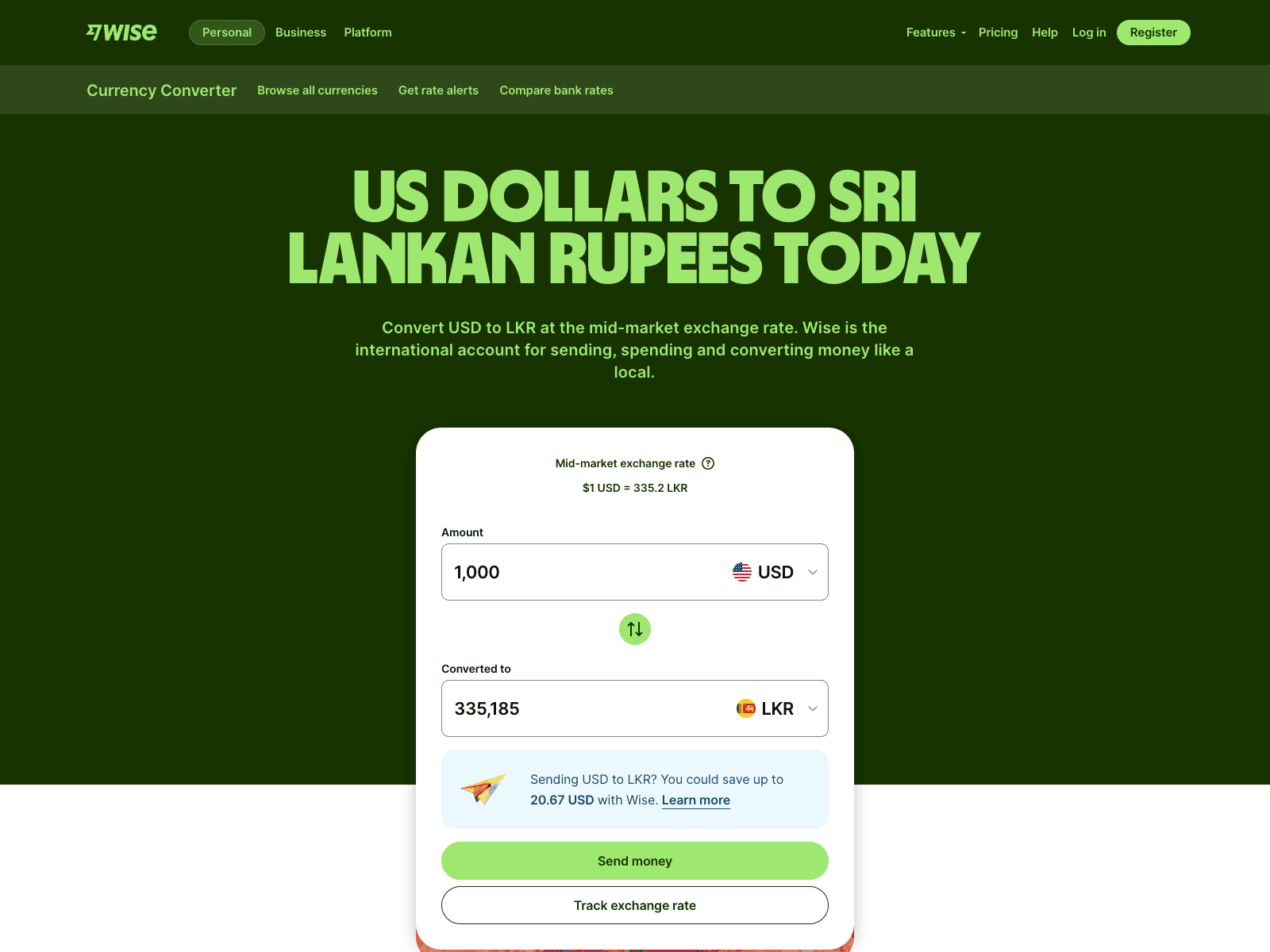
- Mid-market exchange rate, the real rate you see on Google, with no hidden markup added on top.
- Local account details in USD, EUR, GBP, AUD, NZD, SGD, and more, so clients pay you like a local transfer.
- Multi-currency balance, hold and manage 40+ currencies in one account.
- Wise debit card, a physical and virtual card to spend in any currency while travelling or shopping online.
- Transparent fee structure, you see the exact fee and rate before sending or receiving.
- Fast transfers, 90% of payments arrive within 24 hours.
- Available in 160+ countries with support for 40+ currencies.
- No monthly fees, you only pay when you make a transaction.
- Batch payments, send payments to multiple people at once, useful for small agencies.
Pros and Cons of Wise
| Pros | Cons | |
| Exchange Rate | Uses the real mid-market rate with no hidden markup | Small variable fee still applies on top of the rate (typically 0.6–0.7%) |
| Transparency | You see the exact fee and rate before every transaction | Fee structure can feel complex for first-time users |
| Receiving Fees | Free to receive payments via local account details in most currencies | No direct integration with Fiverr, Upwork, or most freelancing platforms |
| Platform Support | Works well for direct client payments and invoice-based work | Not a good fit if most of your income comes through freelancing marketplaces |
| Transfer Speed | 90% of transfers arrive within 24 hours | Occasional delays during compliance or verification checks |
| Card | Physical and virtual debit card available for international spending | Wise card not yet widely supported at all Sri Lankan ATMs |
| Availability | Fully available in Sri Lanka for receiving and withdrawing funds | Does not offer a Sri Lankan LKR local account, only conversion to LKR |
| Fees | No monthly or annual account fees | Withdrawal fees to local bank apply per transaction |
| Trust | 4.3 stars on Trustpilot with 220,000+ reviews | Account freezes can happen during routine compliance checks |
What is PayPal
PayPal is an American financial platform founded in 1998 and is the most widely recognised online payment service in the world. With over 400 million active users across 200+ countries, it is the platform most international clients already know and trust. For buying online, paying subscriptions, sending money, and now receiving international payments in Sri Lanka, PayPal works smoothly almost everywhere in the world.
Following the official launch of full PayPal services in Sri Lanka in May 2026, Sri Lankan users can now send money, receive international payments, and withdraw funds directly to their local bank accounts through approved partner banks.
In terms of how it works, PayPal operates as a digital wallet. You link your bank account or card, and you can send and receive money using just an email address. Clients do not need your bank details, they just need your PayPal email, which makes it extremely easy to get paid quickly.
Here is how it works step by step:
- You create a PayPal account using your email address.
- You link your bank account or debit/credit card to the account.
- You link your PayPal account to an approved Sri Lankan partner bank (Bank of Ceylon, Commercial Bank of Ceylon, or Sampath Bank) through your mobile banking app.
- Your client sends money to your PayPal email address from anywhere in the world.
- The funds land in your PayPal balance.
- You withdraw to your linked Sri Lankan bank account in LKR through your partner bank’s mobile app.
The process is simple and fast. Note that PayPal in Sri Lanka currently supports cross-border payments only. You can receive money from PayPal users abroad, but not from other Sri Lankan PayPal users.
Key Features of PayPal
- Global recognition, accepted by millions of clients, businesses, and online platforms worldwide.
- Pay with email, no need to share bank details, clients just send to your PayPal email.
- Multi-currency support, hold and transact in 25+ currencies.
- Buyer and seller protection, built-in dispute resolution and fraud protection.
- PayPal business debit Mastercard, spend your balance or withdraw at ATMs.
- Batch payouts, send up to 15,000 payments in one batch across 156 countries.
- Integration with e-commerce platforms. Shopify, WooCommerce, and most online stores support PayPal checkout.
- Available in 200+ countries, the widest country coverage of the three platforms.
Can I Receive Foreign Funds Through PayPal in Sri Lanka?
Yes. As of May 2026, Sri Lankan PayPal users can now receive international payments directly into their PayPal account and withdraw funds to a local Sri Lankan bank.
This became possible following the official launch of full PayPal services in Sri Lanka on May 15, 2026, in partnership with three local banks: Bank of Ceylon, Commercial Bank of Ceylon, and Sampath Bank.
To receive and withdraw money, your PayPal account must be linked to at least one of these partner banks through your mobile banking app. Once linked, international clients can send money directly to your PayPal email, the funds appear in your PayPal balance, and you can withdraw to your LKR account through your bank’s app.
One important limitation:
PayPal in Sri Lanka supports cross-border payments only. You can receive money from PayPal users abroad, but you cannot receive money from other Sri Lankan PayPal users. Local peer-to-peer transfers are not supported.
Is It Okay to Open a PayPal Account Under a Foreign Business?
Yes, it is completely legal and in some cases the smarter choice, even now that PayPal works locally in Sri Lanka. Most freelancers who only need to receive client payments through PayPal will be fine with the local setup introduced in May 2026. But for some, setting up a US or UK business and linking PayPal to that foreign entity still makes a lot of sense.
Here is when it is worth doing:
- You also need Stripe, which is still not available in Sri Lanka, and want one foreign business setup that covers both PayPal and Stripe together
- You run an agency or e-commerce business that operates under a US or UK brand and want clients to invoice a foreign entity
- Your enterprise clients prefer or require payments to go through a US or UK registered company
- You want access to higher PayPal transaction limits and fewer account restrictions that come with a foreign business account
If any of these apply, registering a company in the United States or the United Kingdom gives you a fully functional PayPal business account under that entity, a registered business address, a foreign bank account, and the ability to receive international payments without any local restrictions. The entire setup can be done remotely from Sri Lanka without ever traveling abroad.
If you are a solo freelancer with no need for Stripe or a globally branded business presence, the local Sri Lankan PayPal setup is simpler, faster, and costs nothing extra to maintain.
Need Help Registering Your Business in the USA or UK from Sri Lanka?
If you are ready to unlock Stripe and other global payment platforms alongside PayPal, BR.lk helps Sri Lankan freelancers and online sellers set up their business abroad, legally, quickly, and without the stress.
- Expert Guidance and Compliance: Full support through every step of company registration, in line with international and local regulations
- Seamless Payment Setup: Get linked to PayPal, Stripe, Wise, and more, all from Sri Lanka
- Fast and Hassle-Free: Registration and account setup completed in just 24 to 48 hours
- Local Language Support: Personalised assistance available in Sinhala or Tamil
Take the first step to get paid globally and grow your online business with confidence.
Pros and Cons of PayPal
| Pros | Cons | |
| Recognition | Most recognised payment platform globally, clients trust it instantly | High currency conversion markup, up to 4% over the mid-market rate |
| Ease of Use | Simple to send and receive using just an email address | Higher transaction fees compared to Payoneer and Wise |
| Receiving | Now fully supported in Sri Lanka since May 2026, receive international payments directly | Only cross-border payments supported, local Sri Lanka to Sri Lanka transfers are not available |
| Client Compatibility | Most international clients already have a PayPal account | Accounts can be frozen or limited with little warning |
| E-commerce | Deep integration with Shopify, WooCommerce, and online stores | Requires linking to a partner bank to receive and withdraw funds |
| Security | Strong buyer and seller protection with dispute resolution | Partner banks currently limited to Bank of Ceylon, Commercial Bank, and Sampath Bank |
| Withdrawal | Withdraw funds directly to your Sri Lankan bank account via partner banks | Withdrawal fees are set by each partner bank and vary |
| Global Expansion | US or UK company registration gives access to Stripe and other platforms not yet available in Sri Lanka | Foreign company setup involves additional costs, compliance, and maintenance |
Payoneer vs Wise vs PayPal: A Head-to-Head Comparison
Now that you know what each platform does, here is how they stack up directly against each other across the factors that matter most for Sri Lankan freelancers.
Fee Comparison: How Much Do You Actually Keep?

Fees are rarely just one number. Each platform charges at different points, when you receive money, when you convert currency, and when you withdraw to your bank. Here is a full breakdown so you know exactly where your money goes.
Payoneer is generally free to receive from platforms like Fiverr and Upwork, but charges when clients pay you directly. Wise charges a small transparent fee on conversion but gives you the best exchange rate. PayPal charges the most at almost every step, though Sri Lankan users can now receive and withdraw payments following the May 2026 launch.
| Fee Type | Payoneer | Wise | PayPal |
| Account Opening Fee | Free | Free | Free |
| Receiving from Platforms (Fiverr, Upwork) | Free | Not supported | Not supported |
| Receiving via Local Bank Details | 0% to 1% depending on currency | Free in most currencies | Supported via partner banks. Fees apply |
| Receiving via Credit Card | Up to 3.99% + $0.49 | Not applicable | Up to 4.40% + fixed fee |
| Currency Conversion Fee | 0.5% to 2% markup | 0.6% to 0.7% (mid-market rate) | Up to 4% markup |
| Withdrawal to Sri Lankan Bank | Fee applies per withdrawal | Fee applies per withdrawal | Fees set by partner bank (BOC, Commercial Bank, Sampath) |
| Annual/Dormancy Fee | $29.95 if inactive 12 months | None | None |
| Debit Card Annual Fee | $29.95 | Free (card issuance fee may apply) | Free |
Exchange Rates: Where You Lose the Most Money Without Knowing
The exchange rate is where most freelancers lose money without realising it. A platform can advertise low fees but quietly take a large cut through a poor exchange rate. Here is how each platform handles currency conversion.
Wise is the clear winner here because it uses the real mid-market rate, the same rate you see on Google, and only adds a small transparent fee on top. Payoneer adds a markup over the mid-market rate, which costs you more on larger amounts. PayPal has the highest markup of the three, which means receiving $1,000 through PayPal puts less LKR in your pocket compared to Wise.
| Exchange Rate Factor | Payoneer | Wise | PayPal |
| Rate Used | Wholesale market rate + markup | Real mid-market rate | Mid-market rate + up to 4% markup |
| Conversion Markup | 0.5% to 2% | 0.6% to 0.7% | Up to 4% |
| Rate Transparency | Shown after transaction | Shown before transaction | Shown before transaction but markup is buried |
| Best For | Acceptable for platform payouts | Best for direct client payments | Higher cost option, compare before using |
| Example: Receiving $1,000 | Approx. $985 to $995 after fees | Approx. $993 to $994 after fees | Less than Wise due to higher markup |
Platform and Marketplace Compatibility
If you earn through freelancing platforms, compatibility is one of the most important factors. Not every platform lets you choose how you get paid.
Payoneer dominates here. Most major freelancing platforms have built Payoneer directly into their payout system. Wise is excellent for direct client work but is not integrated into freelancing marketplaces. PayPal now supports direct client invoicing and receiving for Sri Lankan accounts, but is still not natively integrated with most freelancing platforms.
| Platform / Marketplace | Payoneer | Wise | PayPal |
| Fiverr | Yes, native integration | No | No |
| Upwork | Yes, native integration | No | Limited |
| Toptal | Yes | No | No |
| 99designs | Yes | No | No |
| Amazon Marketplace | Yes | No | No |
| Direct Client Invoice | Yes, via payment request | Yes, via local account details | Yes, now supported in Sri Lanka |
| Shopify / WooCommerce | Limited | No | Yes |
| Affiliate Networks | Yes | No | Varies |
Withdrawal Speed to Your Sri Lankan Bank Account
Once money is in your account, how fast does it reach your local bank? This matters when you have bills to pay or need to manage cash flow.
| Speed Factor | Payoneer | Wise | PayPal |
| Processing Time to Local Bank | 2 to 5 business days | 1 to 2 business days | 3 to 5 business days via partner bank |
| Same Day Withdrawal | No | Rarely | No |
| Weekends and Holidays | Delays possible | Delays possible | Delays possible |
| Minimum Withdrawal Amount | $50 | Varies by currency | Set by partner bank |
| Transfer Notification | Yes, email and app | Yes, email and app | Yes, via partner bank app |
Account Setup and Verification
Getting started with any of these platforms requires identity verification. The strictness of the KYC process varies across platforms and can affect how quickly you can start receiving money.
| Setup Factor | Payoneer | Wise | PayPal |
| Signup Process | Online, straightforward | Online, straightforward | Online, straightforward |
| Documents Required | NIC or Passport, bank details | NIC or Passport | NIC or Passport, card details |
| KYC Strictness | Moderate to strict | Moderate | Moderate |
| Approval Time | 1 to 3 business days | 1 to 2 business days | Usually instant |
| Can Receive Money Immediately | No, after verification | No, after verification | No, after verification and bank linking |
| Account Freeze Risk | Moderate | Low to moderate | Moderate to high |
| Local Bank Account Required | Yes, for withdrawal | Yes, for withdrawal | Yes, partner bank required to receive and withdraw |
Safety and Reliability
All three platforms are regulated financial services companies, but their track records and local relevance differ. For Sri Lankan freelancers, the key concern is whether your money is safe and whether the platform is stable enough to rely on as your primary income channel.
| Security Factor | Payoneer | Wise | PayPal |
| Regulatory Status | Regulated in the US (FinCEN) | Regulated in the UK (FCA) | Regulated in the US (FinCEN) |
| PCI DSS Compliance | Yes, Level 1 | Yes, Level 1 | Yes, Level 1 |
| Two-Factor Authentication | Yes | Yes | Yes |
| Fraud Detection | Yes, built-in | Yes, built-in | Yes, advanced |
| Trustpilot Rating | 3.9 stars (53,000+ reviews) | 4.3 stars (220,000+ reviews) | 1.3 stars (Poor rating) |
| Account Freeze History | Reported occasionally | Reported occasionally | Frequently reported |
| Fund Protection | Held in regulated accounts | Held in regulated accounts | Held in PayPal balance |
| Sri Lanka Availability | Fully available | Fully available | Fully available since May 2026 |
Tax and Legal Side for Sri Lankan Freelancers
Earning foreign income through Payoneer, Wise, or PayPal does not mean you are outside the tax system. The Inland Revenue Department (IRD) of Sri Lanka treats freelance income as self-employment earnings, and you are expected to declare it.
Here is what you need to know:
- Income Tax: Freelance income is taxable progressively in Sri Lanka. As of 2026, income above LKR 3,000,000 per year is subject to income tax at rates between 6% and 18%. You are required to file with the IRD and declare all foreign income received.
- Central Bank Compliance: The Central Bank of Sri Lanka permits inward remittances for freelance and export services. Payoneer, Wise, and now PayPal (via partner banks) are all compliant channels for receiving this income. You should keep records of all transactions including invoices, payment confirmations, and bank statements. Proper bookkeeping makes this much easier at tax time.
- Documentation: When you receive payments through any of these platforms, download and save your transaction statements regularly. These serve as proof of income when filing taxes or if the IRD requests documentation.
VAT:
If your annual turnover exceeds LKR 60,000,000, you are required to register for VAT. Most individual freelancers will not reach this threshold, but agencies should keep it in mind.
| Tax / Legal Factor | Payoneer | Wise | PayPal |
| Accepted by IRD as income proof | Yes | Yes | Yes, now applicable |
| Transaction statements available | Yes, downloadable | Yes, downloadable | Yes, downloadable |
| CBSL Compliant Channel | Yes | Yes | Yes, via partner banks since May 2026 |
| Supports Invoice Generation | Yes | Yes | Yes |
| Suitable for Tax Filing Purposes | Yes | Yes | Yes |
Summary Table: Payoneer vs Wise vs PayPal for SL Freelancers
| Factor | Payoneer | Wise | PayPal |
| Available in Sri Lanka | Yes, fully | Yes, fully | Yes, fully since May 2026 |
| Best For | Platform-based freelancers | Direct client work and invoicing | Direct client payments, subscriptions, and e-commerce |
| Account Fee | Free | Free | Free |
| Receiving Fee | Free from platforms, 0 to 1% via bank details | Free in most currencies | Fees apply, check PayPal Sri Lanka fees page |
| Currency Conversion | 0.5 to 2% markup | 0.6 to 0.7% at mid-market rate | Up to 4% markup |
| Exchange Rate | Wholesale rate + markup | Real mid-market rate | Mid-market rate + high markup |
| Withdrawal to LK Bank | Yes, 2 to 5 business days | Yes, 1 to 2 business days | Yes, 3 to 5 business days via partner bank |
| Fiverr / Upwork Integration | Yes, native | No | No |
| Direct Client Payments | Yes, via payment request | Yes, via local account details | Yes, now supported locally |
| Debit Card | Yes, Mastercard ($29.95/year) | Yes, free card | Yes |
| Minimum Withdrawal | $50 | Varies by currency | Set by partner bank |
| Dormancy Fee | $29.95 after 12 months inactive | None | None |
| KYC Strictness | Moderate to strict | Moderate | Moderate |
| Account Freeze Risk | Moderate | Low to moderate | Frequently reported |
| Trustpilot Rating | 3.9 stars | 4.3 stars | 1.3 stars |
| Regulatory Compliance | US regulated (FinCEN) | UK regulated (FCA) | US regulated (FinCEN) |
| CBSL Compliant Channel | Yes | Yes | Yes, since May 2026 |
| Tax Documentation | Yes, downloadable statements | Yes, downloadable statements | Yes, downloadable statements |
| Overall Cost | Moderate | Lowest | Highest |
| Recommended For SL Freelancers | Yes, primary for platforms | Yes, primary for direct clients | Yes, especially for clients who prefer PayPal |
Final Verdict: Which One Should You Pick?

The right platform depends on how you work and where your income comes from. Here is a clear breakdown to help you decide.
If You Work on Freelancing Platforms: Use Payoneer
If most of your income comes through Fiverr, Upwork, Toptal, or any other major freelancing marketplace, Payoneer is your best choice. These platforms have Payoneer built directly into their payout system, the fees are reasonable, and it is fully recognised by the Central Bank of Sri Lanka as a compliant inward remittance channel.
If you are just starting out and unsure which platform to pick, start with Payoneer. It works with almost every marketplace you sign up for.
If You Work with Direct Clients: Use Wise
If you send invoices directly and get paid outside of a marketplace, Wise is the smarter option. You give your client a local USD, EUR, or GBP account number and they pay you like a domestic bank transfer. Wise uses the mid-market rate with a transparent low fee, which means more money lands in your Sri Lankan bank account.
Tip: Use our Wise calculator to estimate exactly what you will receive.
If you have retainer clients who pay monthly, the savings add up significantly over a year.
If Your Clients Prefer PayPal: Use PayPal
Since May 2026, PayPal is now fully available in Sri Lanka. If your clients already use PayPal and prefer it, there is no longer any reason to turn it down. Simply link your PayPal account to one of the partner banks (Bank of Ceylon, Commercial Bank of Ceylon, or Sampath Bank) and you can receive payments and withdraw directly to your LKR account.
PayPal still carries higher fees and a larger currency conversion markup compared to Wise, so it is worth comparing costs before making it your primary platform. But as a receiving option for clients who insist on PayPal, it now works without any workaround.
If you also need Stripe or want to operate under a foreign business entity, registering a US or UK company through BR.lk remains a practical option alongside your local PayPal setup.
When to Combine Two or All Three
The smartest setup for most Sri Lankan freelancers is not choosing just one platform. It is using the right platform for the right type of income. Here is how a combined setup looks in practice:
- Payoneer + Wise (Recommended for most freelancers): Use Payoneer for marketplace earnings and Wise for direct client payments. This combination keeps your fees low and your exchange rate competitive, meaning more money in your Sri Lankan bank account every month.
- Payoneer + Wise + PayPal (For freelancers with diverse client bases): If some of your clients already use PayPal, adding it to your setup is now straightforward. Use Payoneer for platform income, Wise for direct invoice clients, and PayPal for clients who prefer it. No foreign company required for basic receiving.
- Payoneer + Wise + PayPal via Foreign Company (For agencies and global businesses): If you also need Stripe, operate under a US or UK brand, or work with enterprise clients who require invoicing from a foreign entity, setting up a US LLC or UK company through BR.lk opens up the full picture. BR.lk can handle the entire setup remotely from Sri Lanka.
| Your Situation | Recommended Setup |
| Just starting on Fiverr or Upwork | Payoneer only |
| Working with direct international clients | Wise only |
| Clients who prefer PayPal | PayPal (local Sri Lankan account) |
| Mix of platforms and direct clients | Payoneer + Wise |
| Mix of platforms, direct clients, and PayPal clients | Payoneer + Wise + PayPal |
| Agency, e-commerce, or need Stripe | Payoneer + Wise + PayPal + US/UK company via BR.lk |
Key Takeaways
- Payoneer is the best choice for freelancers who earn through platforms like Fiverr and Upwork because of its direct integrations.
- Wise is the most cost-effective option for direct client payments due to its real mid-market exchange rate and transparent fees.
- PayPal is now fully available in Sri Lanka since May 2026, meaning Sri Lankan users can receive international payments and withdraw funds to local bank accounts via partner banks.
- Wise offers the best exchange rates among the three, helping freelancers keep more of their earnings.
- Payoneer charges small fees on currency conversion and withdrawals but remains reliable and widely supported.
- PayPal carries the highest currency conversion markup of the three platforms, so it is worth comparing costs before making it your primary receiving method.
- Wise transfers are usually faster, with most payments reaching Sri Lankan bank accounts within 1 to 2 business days.
- Payoneer is fully compliant with the Central Bank of Sri Lanka and works well for both individuals and agencies.
- PayPal is now also a CBSL compliant channel for receiving inward remittances through its approved partner banks: Bank of Ceylon, Commercial Bank of Ceylon, and Sampath Bank.
- The best setup for most freelancers is Payoneer for platform income, Wise for direct client payments, and PayPal for clients who specifically prefer it.
- Freelancers who also need Stripe or want to operate under a foreign business entity can register a US LLC or UK company through BR.lk to unlock those platforms alongside their local PayPal setup.
FAQs
Wise is generally cheaper for direct client payments, using the real mid-market rate with a 0.6 to 0.7% fee. Payoneer adds a 0.5 to 2% markup. However, if you earn through Fiverr or Upwork, Payoneer is free to receive, making it the cheaper option for marketplace income.
Log in to Payoneer, go to Withdraw, select To Bank Account, and enter your Sri Lankan bank details. The minimum withdrawal is $50 and funds typically arrive within 2 to 5 business days. Withdrawal fees apply per transaction and vary depending on the amount transferred.
Yes. Since May 2026, Sri Lankan users can receive international payments and withdraw to a local bank account. Link your PayPal to an approved partner bank: Bank of Ceylon, Commercial Bank of Ceylon, or Sampath Bank. Note that only cross-border payments are supported, not transfers between Sri Lankan PayPal users.
Not necessarily. PayPal still carries the highest conversion markup, up to 4% above the mid-market rate. Wise remains cheapest for direct client payments and Payoneer is best for marketplace earnings. PayPal works best when clients specifically prefer it or when you need PayPal Checkout for an e-commerce business.